Finance-Books.com

Entrepreneurs · 7 books

The Best Finance Books for Entrepreneurs & Small Business Owners

Seven books on cashflow, pricing, and profitability — the financial side of running a business that nobody teaches you in entrepreneurship school.

Profit First book cover
#1 · Editor's Pick

Profit First

by Mike Michalowicz · 2017

4.6(16,742)

Mike Michalowicz's premise is simple and slightly heretical: traditional accounting (Revenue − Expenses = Profit) makes profit a leftover, which is why most small businesses run on fumes. Flip the formula — Revenue − Profit = Allowable Expenses — and you guarantee profitability by structurally setting it aside first. The implementation is a multi-account system: separate bank accounts for Operating Expenses, Owner's Pay, Tax, and Profit, with rules for what percentage of revenue goes where based on business size. It's been adopted by tens of thousands of small businesses for good reason. The honest caveat: it's not optimal for fast-growing businesses that should be reinvesting heavily, and Michalowicz's writing veers folksy in a way some readers find tedious.
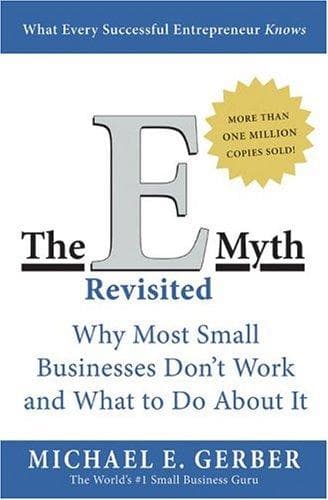
The E-Myth Revisited book cover
#2 · Editor's Pick

The E-Myth Revisited

by Michael E. Gerber · 1995

4.6(12,996)

Michael Gerber's central insight: most small businesses fail because the founder is a technician (a baker, a plumber, a designer) who suddenly has to run a business, and being good at the work doesn't make you good at running the business of the work. His prescription: work ON your business, not just IN it. Build systems, document every process, make yourself replaceable in your own operation — so the business becomes something you own rather than something that owns you. First published in 1986 and revised in 1995, the examples feel dated (the Sarah-running-a-pie-shop narrative is plodding) but the framework has been hugely influential. Almost every "build systems / hire / delegate" framework you'll read since 1995 traces back here.

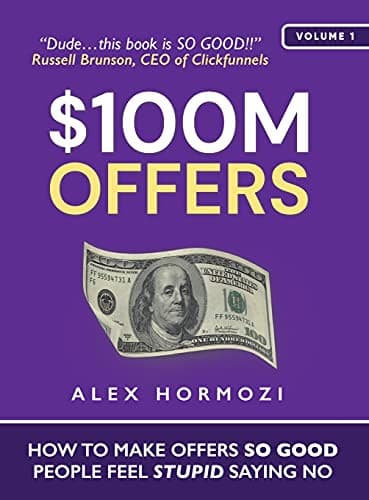
$100M Offers book cover
#3 · Editor's Pick

$100M Offers

by Alex Hormozi · 2021

4.7(31,604)

Alex Hormozi sold his gym-software business for $46M and wrote this book about the single skill that made it possible: constructing offers buyers can't refuse. The framework — the "Value Equation" of dream outcome divided by time delay and effort and perceived risk — is the most operational distillation of B2B persuasion I've read. Hormozi's tone is brash and self-promotional (the book is also a top-of-funnel for his other businesses), but the actual content is unusually concrete: examples, scripts, before-and-after offer comparisons. The book is short, dense, and worth reading twice. It changed how I think about pricing and packaging.

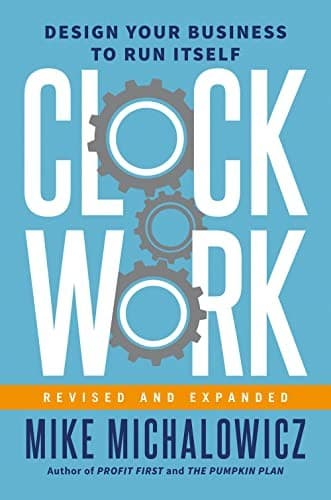
Clockwork book cover
#4 · Editor's Pick

Clockwork

by Mike Michalowicz · 2018

4.5(10,433)

The follow-up to Profit First, this book tackles the other half of the small-business burnout problem: the owner who can't take a vacation without the business falling apart. Michalowicz's prescription — the "4D Mix" of Doing, Deciding, Delegating, and Designing — is a sequence for systematically transferring work out of the owner's head. The book's measurable goal: "the 4-week vacation test." If you can leave your business untouched for 4 weeks and come back to find it functioning, you've built a real business. If not, you've built a job. The framework is more actionable than E-Myth's but covers similar ground; pick one. The 2020 revised edition is significantly better than the original.

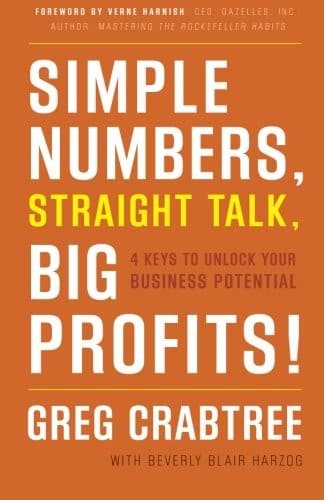
Simple Numbers, Straight Talk, Big Profits! book cover
#5 · Editor's Pick

Simple Numbers, Straight Talk, Big Profits!

by Greg Crabtree · 2011

4.6(11,205)

Greg Crabtree is a CPA who specializes in small businesses, and this is the book he wrote after seeing the same financial mistakes over and over. The thesis: business owners obsess over revenue when the only number that actually matters is the "labor efficiency ratio" — gross profit per dollar of labor cost. The book is dense with specific metrics, target ratios by industry, and worked examples. It's the least entertaining book on this list and the most operationally useful for businesses in the $1M–$10M range. Crabtree's frame — that owner salary should be a market-rate salary FIRST, with distributions ON TOP — is the financial-clarity move most small-business owners are missing.

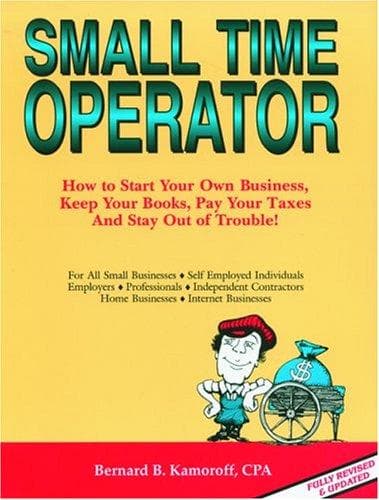
Small Time Operator book cover
#6 · Editor's Pick

Small Time Operator

by Bernard B. Kamoroff · 2020

4.4(10,118)

Now in its 14th edition and updated annually since 1976, this is the most practical and least sexy book on this list — a comprehensive operational manual for actually running a small business: choosing a legal structure, registering for taxes, doing your own bookkeeping, paying yourself, handling employees, navigating insurance. It's not a strategy book or an inspiration book. It's the book your accountant wishes you had read before showing up at their office. Kamoroff is a CPA, the writing is plainspoken, and every chapter answers questions you didn't know to ask. It's the book to own if you've never run a business before — and to keep on the shelf even when you have.

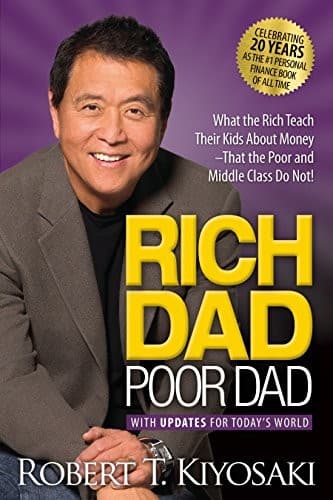
Rich Dad Poor Dad book cover
#7 · Editor's Pick

Rich Dad Poor Dad

by Robert T. Kiyosaki · 1997

4.7(42,815)

Kiyosaki's 1997 book is one of the best-selling personal-finance books of all time, and also the most controversial. The famous frame: Kiyosaki's biological father ("poor dad," a teacher) and his friend's father ("rich dad," a businessman) gave him opposing money advice as a kid; rich dad's won. The core distinction — assets put money in your pocket, liabilities take money out — is genuinely useful and the reason this book has changed millions of people's relationship with money. The honest problems: most of the specific advice (especially on real estate, taxes, and "good debt") is poorly explained, weakly sourced, or actively misleading. Kiyosaki has since pivoted to selling expensive seminars and gold bugs talk. Read it for the mental model, ignore the prescriptions.